





Received Pronunciation

RP is the accent traditionally heard in British newsreading and formal public speech. It isn’t tied to any specific place, but it’s long been linked to education and social status.


TRAP-BATH split
Non-rhoticity (only pronounce /r/ when it's followed by a vowel sound)
There is no /r/-colouring
Modern British RP (a.k.a. SSBE) accents

A modern alternative to RP, Southern Standard British English is the model described in the Handbook of the International Phonetic Association.


Open TRAP vowel
NEAR can be a monophthong (like "niih")
More glottal stops (but limited)
Scottish accents

Although it's a small country with not many more than 5 million people, Scotland has many regional accents alongside the 3 native languages spoken there (Scottish English, Scots, and Gaelic).
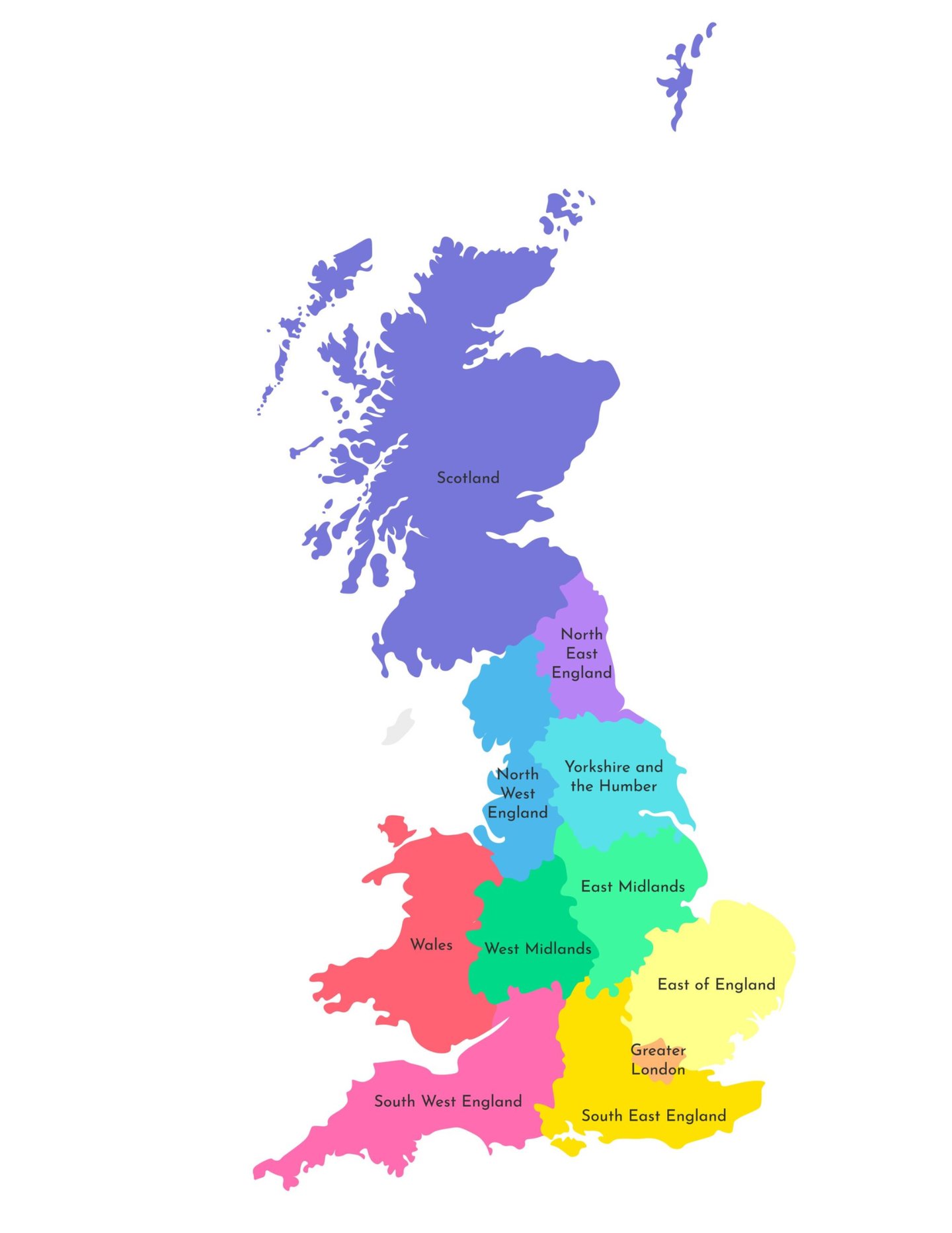
The accents in this region include Central: Glaswegian (Glasgow), Edinburgh, Fife, Stirling, Perthshire; Northeast: Aberdonian/Doric (Aberdeen), Dundonian (Dundee), Ayrshire; Highlands: Invernesian (Inverness); Insular: Orcadian (Orkney Is.), and Shetlandic; Southern: Borders, Dumfries & Galloway


Scottish Vowel Length Rule
Svarabakhti: that wee vowel that pops up
"Dark" versus "light" /l/
The North

Most speakers in the North of England lack both the FOOT-STRUT and TRAP-BATH splits, which spread throughout the south of England.
The FOOT-STRUT split happened during the 17th century and was carried across to the North American colonies.
The TRAP-BATH split happened in the late 18th/early 19th centuries and made it across to the colonies in the southern hemisphere.


Keeping the /h/
Glottal reinforcement
Accent vs. Dialect
Northeast England
Northeast English accents include Geordie (Newcastle/Tyneside), Mackem (Sunderland), Northumbrian (Northumberland and County Durham), Smoggie (Teesside), and Pitmatic (Great Northern Coalfield).
Yorkshire

Yorkshire accents cover a wide range of regional varieties, including West Yorkshire (Leeds, Bradford, Huddersfield), South Yorkshire (Sheffield, Rotherham, Barnsley), East Yorkshire (Hull and the Holderness area), and North Yorkshire (York, Harrogate, Whitby). Each has its own distinct vowel qualities, rhythm, and intonation, often grouped loosely under the label “Yorkshire”.


'Ast 'eard o' t' Definite Article Reduction?
Yorkshire varieties & the winds of constant change
'Appen there's a lorra features of Yorkshire accents
Northwest England

Northwest English accents include Mancunian (Manchester), Scouse (Liverpool), Lancastrian (Lancashire towns and rural areas), Cumbrian (Cumbria), and Merseyside varieties beyond Liverpool itself (such as Wirral and St Helens), each with distinct phonetic features despite their close geographic proximity. Notably, there is also a small area in Lancashire where near-extinct rhoticity can still be heard, making it one of the last places in the north of England where post-vocalic /r/ survives.


Manchester vs. Liverpool: Spot the differences
Manchester vs. Liverpool (an accent feature comparison)
The many types of /t/ in Liverpool accents
The English Midlands

Midlands accents are usually divided into West Midlands and East Midlands.
Most speakers in these regions lack both the FOOT-STRUT and TRAP-BATH splits, which spread throughout the south of England.
West Midlands accents include Black Country (Dudley, Sandwell, Walsall, and Wolverhampton) and Brummie (Birmingham), Coventry, and the Potteries (north Staffordshire).
East Midlands accents include those heard in Derbyshire, Leicestershire, Lincolnshire, Nottinghamshire, and Northamptonshire.


Distinctive features of Midland accents
Midland accents: East vs. West
The extra 'g' in 'ng': velar nasal plus
East Anglia

Found across Norfolk, Suffolk, and parts of Cambridgeshire, East Anglian accents are among the most distinctive yet least accurately represented English accents on stage and screen.
Frequently miscast as either “rural generic” or mistakenly played as West Country, East Anglian accents are in fact highly specific and internally varied. Small changes in vowel shape, pitch movement, and pace can immediately place a speaker socially and geographically.
When handled with care, these accents bring subtlety, restraint, and quiet authority to both period and contemporary work.
Accents in this region include Norwich (Norfolk), Ipswich (Suffolk), Cambridge, and Fenland varieties, each with its own recognisable musicality and articulatory profile.


What's your yod count?
The frontəd START/PALM/BATH vowels and the centred
unstressed /ɪ/ [ə]
The NEAR-SQUARE merger
Southeast England

Southeast English accents, spanning London and the surrounding counties of Kent, Surrey, Sussex and Essex, are among the most frequently requested accents in contemporary performance. Typically non-rhotic, meaning the /r/ is not pronounced at the end of words unless followed by a vowel, these accents are defined by crisp vowel contrasts, forward placement, and a wide range of rhythmic and intonational choices.
Often labelled in casting as “neutral” or “standard”, Southeast accents are anything but uniform. Subtle shifts in vowel quality, tempo, and articulation can signal class, geography, education, and generation within a single line of dialogue. From period drama and modern realism to heightened comedy, these accents offer actors enormous flexibility while demanding precision and control.
Accents in this region include Received Pronunciation (RP)/SSBE, Estuary English, Cockney (Traditional East London), Multicultural London English (MLE), and regional varieties from Kent, Sussex, and Essex.


Where did Cockney go?
What and where is Estuary English?
MLE: A multicutlural wave of a dialect
Southwest England

West Country accents, from Cornwall to Dorset, are some of the most distinctive and evocative in the UK. Known for their melodic, often sing-song quality, these accents are famous for their rhoticity, meaning the /r/ is pronounced strongly at the end of words.
Often stereotyped in the media as rural or folksy, West Country accents are actually diverse, with subtle variations from town to town. Whether in pirate tales, period dramas, or everyday conversation, these accents bring warmth, character, and a deep sense of regional identity.
The accents in this region include Cornish, Devonshire, Bristolian, Dorset, Janner (Plymouth), and Traditional Caulkhead (Isle of Wight).


Whoy poirates?
West Country PRICE and MOUTH vowels
The ever-decreasing Bristol L
Wales

Wales has a distinctive linguistic landscape shaped by long-term bilingualism between Welsh (Cymraeg) and English. Welsh is a Celtic language with its own sound system, grammar, and rhythms, and although English is spoken across the country, Welsh remains a living community language, particularly in the north and west. For many speakers, Welsh is not just a heritage language but a daily means of communication, education, and cultural expression. This sustained contact between Welsh and English has left a clear imprint on the English spoken in Wales: Welsh English accents reflect features of Welsh phonology, intonation, and syntax in ways that differ markedly from English accents elsewhere in Britain. As a result, Welsh English is not a single accent but a spectrum of regional varieties, all shaped to varying degrees by the underlying presence of Cymraeg.


An old sound lost in English accents, fossilized in Wenglish
What are the differences between North and South Walian accents?
CH, RH, and LL are 3 letters that bring a unique flavour to Welsh English
© 2026 TalkLikeThat
Dialect Coaching by Mark Byron Dallas
Toronto, Canada